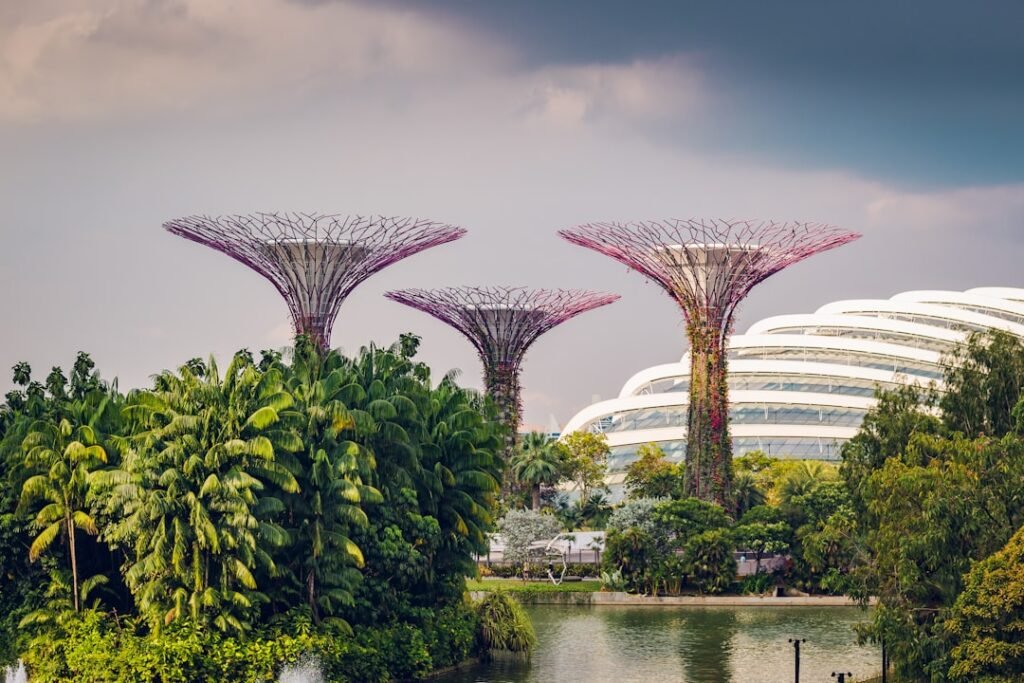
Singapore’s Building and Construction Authority (BCA), the statutory agency that regulates the city-state’s built environment, retired its decade-old green-building certification framework on September 2, 2026, unveiling Green Mark Version 7 (GM v7) at the International Built Environment Week (IBEW) 2026 opening ceremony, according to the Singapore Green Building Council (SGBC) and BCA’s own Green Mark v7 program documentation. The change carries a hard compliance deadline: BCA will accept no new applications under the outgoing Green Mark 2021 standard after April 1, 2027, and every project still certifying under that standard must close out by the end of 2027 — turning what reads as a technical refresh into a seven-month decision window for every building owner with a certification in the pipeline.
The choice landing on every Singapore building owner’s desk this quarter
Two standards now run in parallel. GM:2021, the current version, keeps accepting new submissions only until April 1, 2027, per BCA’s published transition rules. GM v7 replaces it with a restructured Energy Rating pathway carrying seven tiers — EE45, EE50, EE55, SLE60, SLE70, ZE and PE — each set as a minimum percentage of energy savings against a 2005 baseline, with ZE requiring a 100% renewable offset and PE requiring 115% onsite renewable generation, according to BCA’s Green Mark v7 criteria.
GM v7 also introduces portfolio certification: an owner with multiple similar buildings can file them under a single “parent” application instead of repeating the submission for each asset, BCA states — a direct cost reduction for REITs (real estate investment trusts) and other multi-asset landlords that dominate ASEAN’s commercial building stock.
Option A: certify now under the old standard
For owners already mid-audit under GM:2021, finishing under the familiar rubric before the April 2027 cutoff avoids retraining consultants and assessors on a new framework mid-project. BCA’s transition notice makes the cost of hesitation explicit: any GM:2021 project not completed by the end of 2027 has no extension path — it simply lapses.
The trade-off is that GM:2021 certification will age against a scheme built around 2005-era efficiency assumptions, just as GM v7 was developed in consultation with more than 150 organizations and 280 professionals, including financial institutions, according to SGBC — meaning the lenders who write green loans are already being briefed on the new tiers, not the old ones.
Option B: wait for Green Mark v7 and bank SLE70
The more consequential change for ASEAN’s tropical building stock sits inside the SLE70 tier — a new frontrunner category requiring 70% energy savings over the 2005 baseline, which for the first time lets Alternative Cooling Technologies (ACTs) such as hybrid cooling, passive displacement cooling and radiant cooling count toward that performance offset, per BCA’s v7 criteria. That is a direct answer to the tropical-climate cooling penalty this blog has previously traced through Singapore’s liquid-cooling standard for data centers (SS 726:2026) — GM v7 extends the same alternative-cooling recognition to ordinary commercial buildings, not just data halls.
Two further changes cut recurring cost for owners who wait: maintainability criteria are streamlined by roughly 60%, with the assessment weighted toward actual maintenance outcomes rather than paperwork, and buildings that sustain their energy targets qualify for an extended certification validity of five years, up from three, according to BCA. For a facilities team currently recertifying every three years largely to prove upkeep on paper, that is a real reduction in administrative overhead — not just a compliance rebrand.
The trade-off ASEAN portfolios outside Singapore should watch
Green Mark has functioned as a reference standard well beyond Singapore’s borders, informing green-building benchmarks adapted across the region. Financing schemes tied to Singapore’s existing Green Mark Incentive Scheme for Existing Buildings (GMIS-EB), which grants up to S$1.2 million per project toward Super Low Energy retrofits, currently qualify buildings that reach Green Mark SLE certification — a tier definition that GM v7 has now restructured around the new EE45-through-PE tier ladder, per BCA’s GMIS-EB terms. Portfolio managers who assumed a GM:2021 SLE certification permanently locks in favorable green-loan pricing should confirm with lenders how — and whether — that qualification carries over once the old standard sunsets.
The stakes are systemic rather than cosmetic: buildings account for more than 20% of Singapore’s carbon emissions, BCA notes, which is the reason the agency chose a harder energy bar over a softer compliance rebrand. Building owners across Bangkok, Jakarta, Kuala Lumpur and Manila who benchmark against Singapore’s Green Mark for tenant ESG credentials or green-loan eligibility now have the same seven-month clock, even though the deadline itself is Singapore’s.
Key takeaways
- BCA launched Green Mark v7 on September 2, 2026, and will stop accepting new applications under the outgoing Green Mark 2021 standard from April 1, 2027, with all ongoing GM:2021 projects required to close out by the end of that year.
- GM v7’s new Energy Rating pathway sets seven tiers from EE45 to PE, and its new SLE70 tier is the first to let Alternative Cooling Technologies — hybrid, passive displacement and radiant cooling — count toward the energy-savings threshold.
- Maintainability requirements are streamlined by about 60%, and buildings that sustain their energy performance gain a validity extension from three years to five, cutting recurring recertification cost for facilities teams.
- Portfolio owners with multiple similar buildings can now file one “parent” certification instead of submitting separately per asset, a direct cost saving for REITs and multi-asset landlords.
- Owners mid-certification have roughly seven months to decide whether to close out under GM:2021 or shift to v7’s SLE70 and portfolio provisions before green-loan criteria tied to Green Mark tiers are redefined around the new standard.