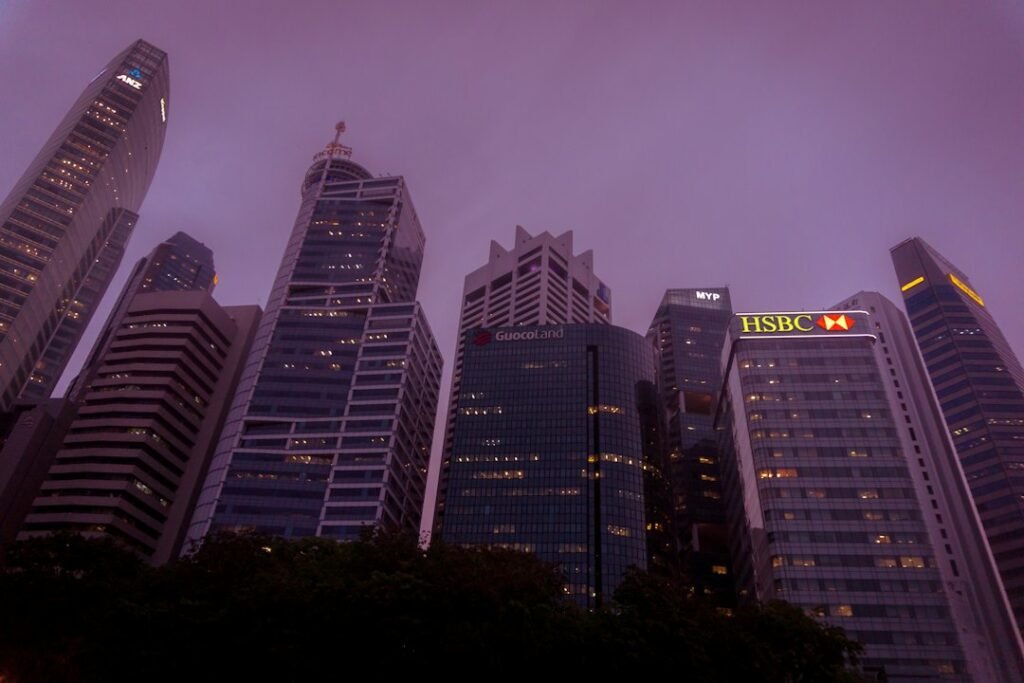
What OUE REIT’s Record GRESB Score Actually Paid For
OUE REIT, the Singapore-listed real estate investment trust that owns OUE Bayfront, One Raffles Place and a portfolio of Central Business District office and retail assets, retained its four-star rating in the 2026 Global Real Estate Sustainability Benchmark (GRESB) assessment with a record score of 88.7 — its third consecutive year at that level — according to a release carried by PR Newswire and Manila Times on October 1, 2026. The milestone the release led with was not a solar array or a lighting upgrade. It was a decommissioned chiller plant.
OUE Bayfront earned its sustainability credit by connecting to the Marina Bay District Cooling System, the centralised chilled-water network that Singapore utility SP Group designed, built and operates across the city’s financial district. The same release noted that One Raffles Place Shopping Mall separately became the first retail mall in Singapore to attain EDGE Advanced certification, a green-building standard administered by the International Finance Corporation. Both achievements fed the same score. Only one of them freed up real estate.
The Chiller Room That’s Worth More as an Office
OUE REIT disclosed in March 2026 that it would spend up to $43 million converting roughly 22,604 square feet of now-redundant chiller plant space at OUE Bayfront into prime office floors, according to EdgeProp Singapore and Yahoo Finance Singapore. The trust is projecting a stabilised return on investment above 11 percent once the conversion completes in the first half of 2027 — a figure the reporting flagged as running ahead of typical asset-enhancement returns in the Singapore CBD.
The conversion is only possible because the building no longer needs its own mechanical cooling plant. Once OUE Bayfront drew chilled water from SP Group’s network instead, the space its chillers, pumps and cooling infrastructure used to occupy became ordinary floor area — and in a CBD where rentable space commands a premium, that floor area is worth more let to a tenant than it ever was running air-conditioning equipment.
What District Cooling Costs an Owner That a Chiller Plant Doesn’t
The Marina Bay system, established in 2006 and described by its operator as the world’s largest fully underground district cooling network, currently serves roughly 23 developments across Marina Bay Sands, Gardens by the Bay, the Marina Bay Financial Centre and surrounding towers, according to SP Group’s own media releases. The network is expanding toward 28 connected developments and 75,000 refrigeration tons of installed capacity by 2027, up from 73,000 RT today.
That expansion is deliberate, not automatic. A building earns a connection slot, not an entitlement, and the network’s footprint stops at the edge of Marina Bay — a CBD tower in, say, Novena or Raffles Place proper outside the service radius has no equivalent swap to make. Joining also means trading a capital asset for a service contract: the chiller plant that disappears from a building’s balance sheet is replaced by a long-term pricing relationship with a single counterparty, SP Group, for a utility the building can no longer produce for itself. OUE Bayfront’s trade only pencils out because the office rent it can now collect outvalues both the chiller plant’s replacement cost and the cooling bill the network charges in its place.
The Decision Facing a Portfolio Manager Still Running an In-House Plant
For an ASEAN building owner, OUE Bayfront’s numbers are a template for a trade that only a minority of commercial towers are positioned to make. Inside a district cooling service area, the arithmetic is the one OUE REIT just ran publicly: price the capex to decommission the plant against the leasable area it frees, not against the energy savings alone, because the energy savings were never going to justify $43 million on their own.
Outside a network’s footprint — which is most commercial buildings in the region, including the majority of towers in Singapore itself — the lesson still transfers, just differently. A chiller plant nearing replacement is not only a maintenance liability; it is square footage sitting idle under a cooling tower that an owner has never priced as real estate. Before authorising another like-for-like chiller replacement, a portfolio manager should ask what that mechanical floor would be worth with a tenant in it instead, whether or not district cooling is the thing that gets it there.
Key takeaways
- OUE REIT’s record 88.7 GRESB score, reported October 1, 2026, was anchored by a decommissioned chiller plant rather than a new certification.
- OUE Bayfront is spending up to $43 million to convert roughly 22,604 square feet of former chiller space into office floors, targeting a stabilised ROI above 11 percent once work completes in the first half of 2027.
- The conversion is only possible because OUE Bayfront joined SP Group’s Marina Bay District Cooling System, which serves around 23 developments today and is expanding toward 75,000 refrigeration tons of capacity by 2027.
- District cooling trades an owned chiller asset for a pricing dependency on a single utility counterparty, and the trade is only available inside the network’s service footprint.
- Portfolio managers outside a district cooling zone face the same arithmetic in a different form: a retired chiller plant is leasable floor space, and that return can outrun the energy-savings case that justified decommissioning it in the first place.